
Why Ireland’s Dog Welfare Laws Must Change to End Industrial Puppy Farming
Why Ireland’s Dog Welfare Laws Must Change to End Industrial Puppy Farming:
By Darragh Bourke, Owner – Big Bark News & Media
Ireland likes to present itself as a nation of dog lovers. Our dogs are family members, companions, and a source of comfort and joy in our lives. Yet behind this image lies a reality that is deeply uncomfortable and impossible to ignore: Ireland has earned the label of the puppy farm capital of Europe, and it is a reputation we have done far too little to challenge.
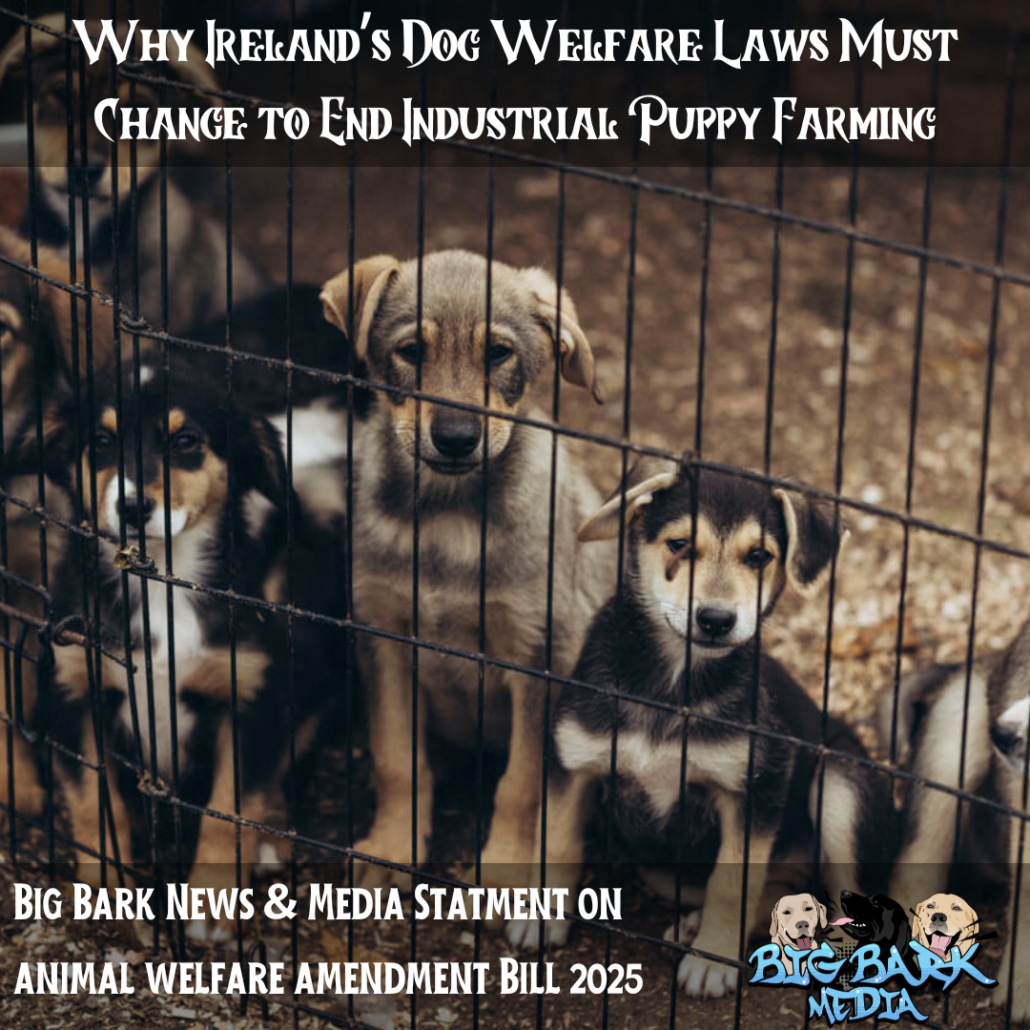
For years, weak regulation, poor enforcement and political hesitation have allowed large-scale commercial dog breeding to flourish. Tens of thousands of puppies are bred annually on this island, many for export, while their mothers endure lives of repeated breeding, confinement and neglect. This is not an accident of the system — this is the system.
Outrage at Industrial-Scale Puppy Farming
At Big Bark News & Media, we are outraged that in modern Ireland industrial puppy farms can legally operate with hundreds of breeding dogs on a single site. Some of the largest facilities on the island are permitted to keep up to 900 breeding bitches, many of whom are producing more than two litters per year on average.
This level of exploitation would be unthinkable in almost any other area of animal welfare — yet it is tolerated when profit is involved.
This reality was laid bare in the Channel 4 documentary In Too Deep by Kyle Thomas, which investigated large-scale puppy farming and the supply chains feeding the UK and European puppy trade. Central to that investigation was Hamilton’s Farm, a large commercial breeding operation in Northern Ireland, repeatedly cited as one of the most significant high-output puppy breeding sites operating on the island.
The documentary highlighted the industrial scale of the operation, the concentration of breeding businesses registered to a single location, and the sheer volume of puppies being produced year after year. Regardless of jurisdictional boundaries, the exposure of Hamilton’s Farm demonstrated what happens when scale is prioritised over welfare — breeding dogs reduced to units of production, with their physical and psychological needs secondary to output.
While the programme focused heavily on the UK market, the implications for Ireland are impossible to ignore. This is the same model of large-scale breeding that Irish legislation has historically allowed to exist and expand.
This is not responsible breeding. It is factory farming of dogs.
Why the Animal Welfare (Amendment) Bill 2025 Is So Important
Against this backdrop, the Animal Welfare (Amendment) Bill 2025, introduced by Social Democrats TD Jennifer Whitmore last thursday, represents a long-overdue and genuinely meaningful step in the right direction.
Ireland’s current framework, based largely on the Dog Breeding Establishments Act 2010, is fundamentally flawed. It places no realistic cap on the scale of breeding operations, allows excessive lifetime breeding, and fails to prioritise the physical and psychological wellbeing of dogs.
Jennifer Whitmore’s Bill proposes critical reforms, including:
-
A cap on the number of breeding bitches per establishment (30 breeding bitches)
-
Clear minimum and maximum breeding ages (no younger than 15 months, no older than 8 years)
-
Limits on the number of litters a female dog can produce annually and over her lifetime (4 litters)
-
Improved standards around staffing, care and oversight (10:1 staffing ratio)
-
Stronger protections for puppies before they are separated from their mothers (minimum separation age – 10 weeks)
These proposals acknowledge what animal welfare advocates have said for years: scale matters, and welfare cannot be guaranteed in massive, industrial breeding facilities.
This Bill does not go far enough on its own — but it is a vital foundation for future reform.
Ireland: The Puppy Farm Capital of Europe
On the Limerick Today Show with Joe Nash, I described Ireland as the puppy farm capital of Europe — not to provoke, but to reflect reality. That label exists because Ireland exports puppies at scale while failing to adequately protect the dogs left behind in breeding sheds.
Rescue organisations, welfare groups and vets across the country are dealing daily with the fallout: traumatised animals, genetic health issues, behavioural problems and overwhelmed rescue systems. The cost of inaction is being paid by charities and volunteers, while the profits flow elsewhere.
This is not just an animal welfare issue — it is a moral failure.
We Must Do More
While we strongly welcome Jennifer Whitmore’s Bill, Ireland must be braver. Incremental reform cannot be the end goal when the suffering is so widespread and so well documented.
We need:
-
Stronger enforcement powers for local authorities
-
Proper resourcing for inspections and prosecutions
-
Meaningful penalties that act as deterrents, not minor business costs
-
A national commitment to reducing large-scale commercial breeding in favour of genuine welfare-led practices
Most importantly, we need political leadership that is willing to say clearly: dogs are not commodities.
Our official Position:
At Big Bark News & Media, we fully support the Animal Welfare (Amendment) Bill 2025 and commend Jennifer Whitmore for bringing this issue back into the national conversation. We urge all TDs and Senators to support it and to commit to building on it with even stronger protections in the years ahead.
Ireland can and must do better for its dogs. Until we confront the reality of puppy farming head-on, our reputation — and our conscience — will remain stained.

