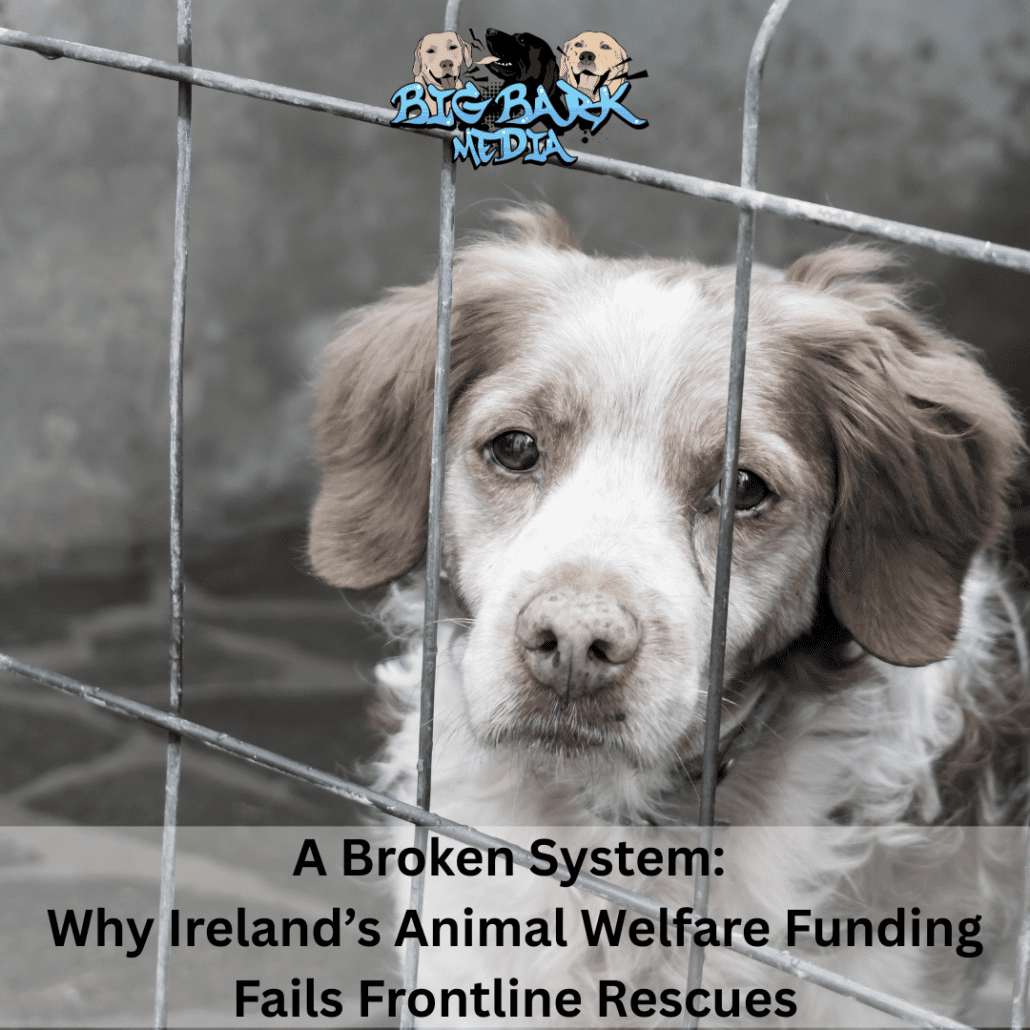

A Broken System: Why Ireland’s Animal Welfare Funding Fails Frontline Rescues
The Big Bark Podcast wishes to formally respond to the Department of Agriculture, Food and the Marine’s recent announcement confirming €6.4 million in funding allocated to 94 animal welfare charities across Ireland.
While any increase in funding for animal welfare is welcome in principle, we must state clearly and unequivocally that the current funding model — and its outcomes — are deeply concerning and wholly unjust.
A DISPROPORTIONATE AND FUNDAMENTALLY FLAWED ALLOCATION
Based on the published figures, approximately one third of the entire funding allocation was awarded to a single organisation — the newly established NSPCA.
This organisation was formed earlier this year following the merger of the DSPCA and ISPCA.
To place this allocation in context, DSPCA’s 2024 consolidated financial statements show a turnover exceeding €4.5 million, with substantial income generated through:
-
Boarding services (€1.24 million)
-
Donations and memberships (€958,000)
-
Rehoming fees (€308,000)
These figures clearly demonstrate access to robust commercial and fundraising income streams that many rescues across Ireland simply do not — and cannot — access.
FRONTLINE RESCUES LEFT BEHIND
In stark contrast, numerous small and medium-sized rescues operating at the coalface of Ireland’s animal welfare crisis received minimal funding, despite being overwhelmed by rising intake, veterinary costs, and chronic capacity issues.
Examples from the lower end of the funding scale include:
-
MADRA – €40,000
-
Limerick Animal Welfare – €120,000 (~5% of NSPCA’s allocation)
-
My Lovely Horse Rescue – €90,000
-
Longford SPCA – €4000
-
Mayo SPCA – €36,375
-
Star Rescue – €34000
-
West Cork Animal Welfare Group – approx. €40,000
-
KWWSPCA – approx. €80,000
-
Haven Rescue – €25000
-
Mollie Moos Rescue – €4000
-
A Dogs Life – €5000
To put this disparity into perspective, some of these rescues received less than 5% of the funding awarded to the NSPCA, despite dealing daily with abandonment, cruelty cases, emergency veterinary interventions, and long-term rehabilitation — often with no paid staff and entirely volunteer-led operations.
OUTRAGE IS NOT ONLY JUSTIFIED — IT IS NECESSARY
The Big Bark Podcast believes that public outrage is both understandable and warranted.
Many of these smaller rescues:
-
Have no boarding facilities
-
Cannot generate income through training, kennelling, or commercial services
-
Are already subsidising the State by stepping in where statutory enforcement and resources fall short
Yet they are expected to survive on crumbs, while organisations with established infrastructure and income-generation capacity receive vastly disproportionate allocations.
This is not a reflection of need.
This is not equity.
And it is certainly not a sustainable approach to animal welfare.
A SYSTEM THAT REWARDS SCALE OVER SUFFERING
The current funding framework appears to prioritise organisational scale and administrative capacity, rather than:
-
Volume of animals rescued
-
Severity of welfare cases handled
-
Reliance on volunteer labour
-
Lack of alternative income streams
This approach risks entrenching inequality within the sector and pushing smaller rescues — many of whom are lifelines in their communities — to breaking point.
A CALL FOR URGENT REFORM
The Big Bark Podcast calls for:
-
A transparent, needs-based funding review
-
Greater weighting for rescues without commercial income
-
Recognition of the critical role played by small, specialist, and breed-specific charities
-
Meaningful consultation with frontline organisations before future allocations
Animal welfare funding must not become a balance-sheet exercise.
It must be grounded in fairness, urgency, and the real conditions faced by those doing the hardest work with the fewest resources.
Ireland’s animals deserve better.
And so do the people who fight for them every single day.
The Big Bark Podcast
Advocating for animals. Amplifying the voices of rescue.
